
From Brittle Zaps to a 24/7 Digital Workforce

Table Of Content
- TL;DR
- The Limit of “More Zaps” as a Growth Strategy
- What a Digital Workforce Actually Looks Like
- Designing Digital Workers Inside Your Agency
- Implementation: Discover → Design → Deploy
- What Changes When You Have a 24/7 Digital Workforce
- If You’re an Agency or SaaS Operator, Here’s the Next Step
- Related posts
- Sources
TL;DR
Zaps and scenarios are great for wiring tools together—but as you grow, they turn into a fragile Rube Goldberg machine. A 24/7 digital workforce replaces that fragility with named AI workers that own outcomes like “onboard new clients in 5 days” and “ship accurate weekly reports,” using your existing stack as an API surface. You stop hiring humans to babysit automations and start hiring digital workers to own lanes in your ops.
From Brittle Zaps to a 24/7 Digital Workforce

If you run an agency or SaaS business, you already know the playbook.
You start with a few zaps. Maybe a Make scenario. A Notion database. A couple of Airtable bases and some Google Sheets.
For a while, it feels magical. New client signs? A zap fires, a board updates, a welcome email goes out. You share screenshots with the team and say, "Look, it's all automated."
Then you grow.
More clients, more edge cases, more tools, more hands in the system. The once‑beautiful web of automations turns into a brittle Rube Goldberg machine. A single API change or field rename silently breaks a critical flow. A client chases you for a report that should have gone out three days ago. Nobody saw the error email. Nobody owned the outcome.
This piece is about the moment you stop asking “How do we add more zaps?” and start asking “How do we hire a digital workforce?”
See also: Beyond Zaps: Building a 24/7 Digital Workforce Inside Your Agency, From Brittle Automations to a 24/7 Digital Workforce, and AI Digital Workers Should Own Outcomes, Not Tasks.
The Limit of “More Zaps” as a Growth Strategy
Every automation story I hear starts the same: "We’ve automated a bunch of stuff, but…"
The “but” usually sounds like:
- “We still end up doing a ton of manual checks.”
- “Every new client adds another layer of complexity.”
- “I’m scared to touch old zaps because I don’t know what will break.”
Zapier, Make, and n8n are excellent at:
- connecting APIs and tools quickly,
- handling simple, linear workflows,
- letting non‑engineers ship automations.
They are not designed to be persistent operators with KPIs.
Underneath, your stack often looks like this:
No concept of:
- Ownership – who is accountable if this flow fails?
- SLA – what turnaround is this automation responsible for?
- Escalation – what happens when the unexpected happens?
You have tasks. You don’t have workers.
See also: AI Agents, Digital Workers, and the End of Brittle Ops for more on the “brittle ops” failure modes.
What a Digital Workforce Actually Looks Like
Instead of a zoo of disconnected automations, you install a handful of AI workers, each with a clear mandate.
Examples:
- Client Onboarding Worker – ensures every Closed‑Won deal becomes a fully onboarded client within 5 business days.
- Reporting & Insights Worker – ships accurate weekly/monthly reports per client and flags anomalies.
- CRM Hygiene Worker – keeps pipeline clean, filled, and consistent.
Workers aren’t tied to one tool. They treat your stack as an API surface:
- “Get me all open deals with these properties.”
- “Create a new client workspace with this schema.”
- “Post a message in this channel if an SLA is at risk.”
Internally, each worker:
- runs 24/7,
- remembers context across runs,
- has metrics and logs,
- escalates to humans with context instead of failing silently.
You can think of them as a new layer between your people and your tools.
Designing Digital Workers Inside Your Agency
We use a simple rule of thumb when designing workers:
"If we fired this worker tomorrow, which KPI would we expect to drop?"
If no KPI obviously drops, it’s not a worker. It’s a tool.
Patterns that work well for agencies:
- Onboarding Worker – owns “client is live within N days”.
- Reporting Worker – owns “reports go out on time and reconcile to source systems”.
- SLA Worker – owns “tickets or projects meet agreed response and resolution times”.
Compare that to the usual script/zap checklists and you can feel the difference in altitude.
See also: AI Digital Workers Should Own Outcomes, Not Tasks for a deeper KPI‑centric design frame.
Implementation: Discover → Design → Deploy
The rest of this piece walks through a four‑phase rollout ( Discover → Design → Deploy → Scale ) you can adapt to your own shop. The key moves:
- Map your work, not your tools. Start from onboarding, delivery, reporting, renewals—not from “What does Zapier integrate with?”.
- Choose 3–5 high‑impact workflows. Look for high volume, repeatable, rules‑driven work where mistakes are annoying but not catastrophic.
- Design workers like roles. Give each a name, mission, inputs, outputs, SLAs, and escalation rules.
- Integrate with your stack. Use zaps, Make, n8n, direct APIs, whatever you already trust. The worker orchestrates; the tools execute.
- Launch with humans in the loop. Let workers draft and propose; humans approve and tune.
After 30–90 days you want to be able to say: “We now have 3–5 digital workers that collectively reclaimed 30–50% of the repetitive work in these lanes.”
That’s the goal of Poly’s own Digital Workforce Launch for agencies and SaaS.
What Changes When You Have a 24/7 Digital Workforce
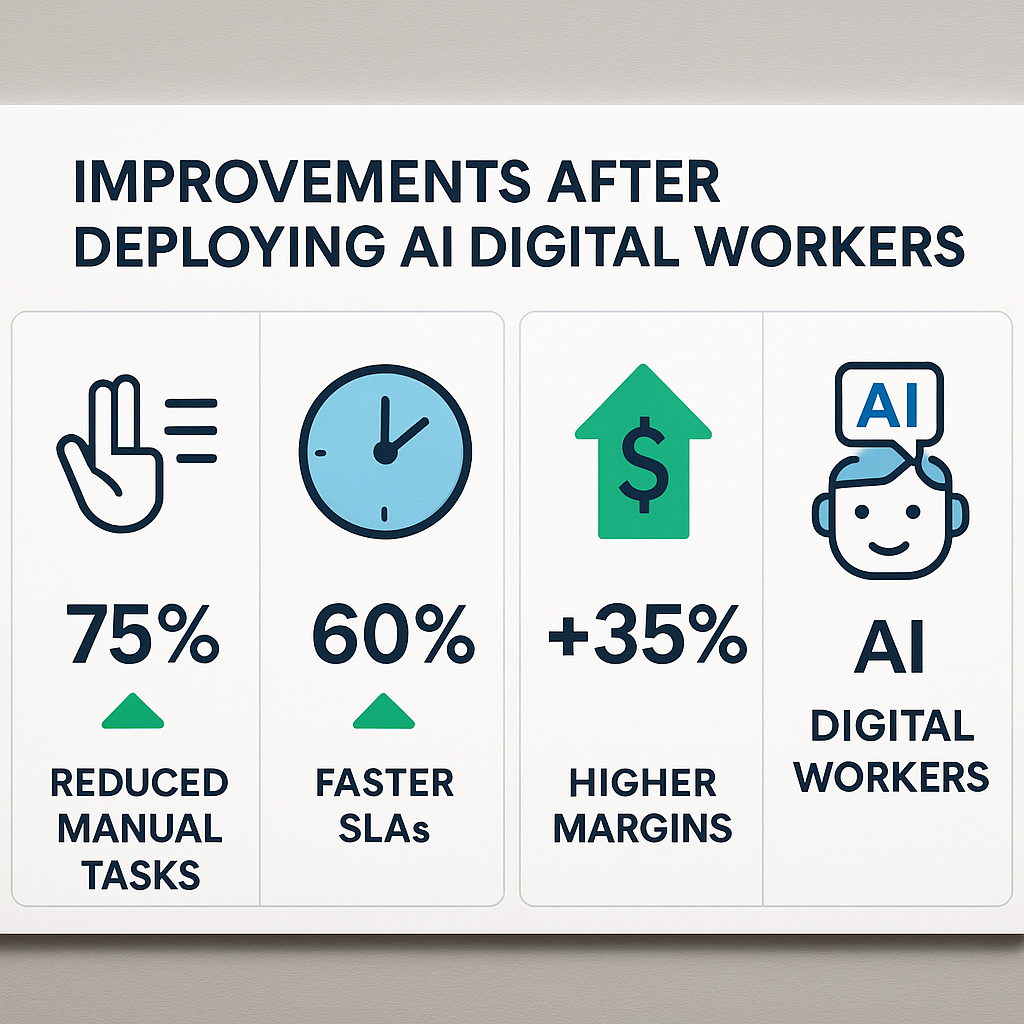
When digital workers are in place, a few things shift:
- You stop assuming every new client requires more coordinators.
- You gain real operational visibility: what each worker did, where it struggled, what it escalated.
- Your best people spend more time on strategy, relationships, and creative problem‑solving—and less time copy‑pasting and reconciling.
The biggest change is qualitative: fewer “oh shit” moments, fewer mystery failures, more calm.
If You’re an Agency or SaaS Operator, Here’s the Next Step
If this all sounds uncomfortably familiar—late‑night reporting, zap sprawl, automations that still require babysitters—you’re squarely in the zone where a digital workforce pays off.
You don’t need to rebuild everything. Start with:
- one worker,
- one workflow,
- one KPI,
- one 60–90 day window.
If that worker can’t remove 30–50% of the repetitive work in its lane while keeping SLAs intact, you can adjust or retire it.
If it does deliver, you’ve just added a new pattern to your business: instead of hiring more zaps or more humans, you can hire another worker.
See also: Beyond Zaps: Building a 24/7 Digital Workforce Inside Your Agency, From Brittle Automations to a 24/7 Digital Workforce, and AI Agents, Digital Workers, and the End of Brittle Ops for adjacent playbooks.
Related posts
- AI Digital Workers Should Own Outcomes, Not Tasks
- Beyond Zaps: Building a 24/7 Digital Workforce Inside Your Agency
- From Brittle Automations to a 24/7 Digital Workforce
Sources
- Public comparisons of Zapier, Make, and n8n on complexity vs maintainability.
- AI and automation research on productivity and ops (McKinsey, Accenture, ServiceNow, etc.).
- Internal Poly experiments deploying digital workers across onboarding, reporting, and lead ops.
See also: AI Digital Workers Should Own Outcomes, Not Tasks, Beyond Zaps: Building a 24/7 Digital Workforce Inside Your Agency, From Brittle Automations to a 24/7 Digital Workforce, and AI Agents, Digital Workers, and the End of Brittle Ops.