
The Future of AI: From Chatbots to Civilizational Infrastructure

Table Of Content
- TL;DR
- Contents
- The current misconception: AI is a feature
- Phase change: from model demos to operating systems
- The next stack: models, agents, tools, and the trust layer
- What gets commoditized (and what doesn’t)
- Work and the economy: where disruption actually lands
- Governance: why regulation will look like finance + aviation
- A practical playbook: how to prepare now
- What I’d bet on in 2030
- Sources
The Future of AI: From Chatbots to Civilizational Infrastructure
TL;DR
- AI is becoming infrastructure: embedded everywhere, priced like a utility, and governed like a critical system.
- Models will keep improving, but the bigger shift is agents + tools + workflows (AI that can actually do work).
- Competitive advantage moves from “having the best model” to having the best trust layer: QA, audits, policy, and observability.
- The labor market impact is real—but it will be uneven, role-specific, and largely determined by whether organizations redesign processes.
- The next decade belongs to teams who treat AI like production capacity: measurable throughput, low defect rates, and fast cycle time.

Contents
- The current misconception: AI is a feature
- Phase change: from model demos to operating systems
- The next stack: models, agents, tools, and the trust layer
- What gets commoditized (and what doesn’t)
- Work and the economy: where disruption actually lands
- Governance: why regulation will look like finance + aviation
- A practical playbook: how to prepare now
- What I’d bet on in 2030
The current misconception: AI is a feature
Most people still talk about AI as if it’s a feature you “add” to a product.
That framing is already obsolete.
A feature is optional. Infrastructure is not.
The future of AI looks less like a clever assistant in a sidebar—and more like electricity in the walls. You don’t think about it. You design around it.
That shift is happening because two forces compound:
- Cost collapse: once intelligence becomes cheap and available on-demand, it stops being special and starts being assumed.
- Integration depth: the more AI is integrated into systems of record (CRM, ERP, ticketing, billing, identity), the more it becomes a default execution layer.
The practical consequence: the question isn’t “Should we use AI?” It’s “What parts of our organization become software when intelligence is basically free?”
Phase change: from model demos to operating systems
The last few years were dominated by model spectacle: bigger context, better benchmarks, better demos.
The next era is dominated by operations.
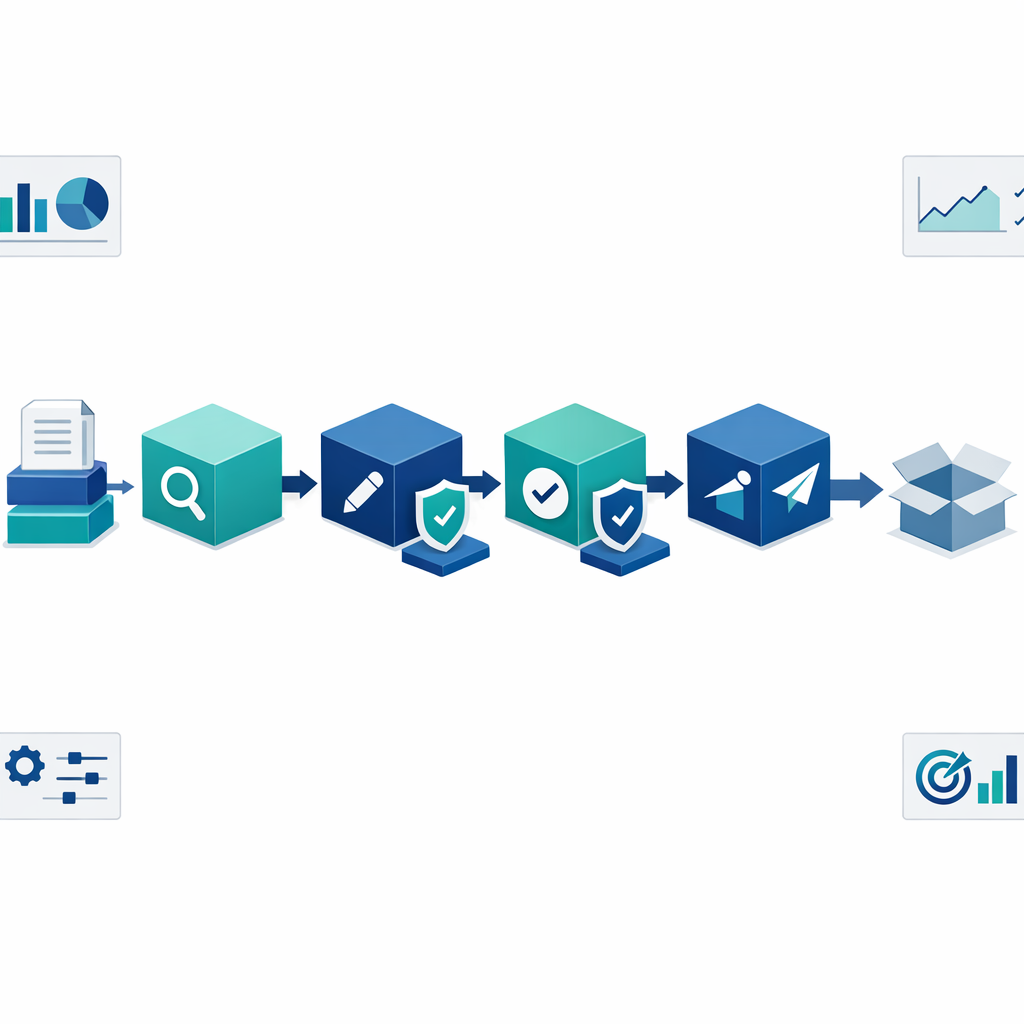
If a model can write an email, that’s interesting. If an agent can:
- pull the correct customer context from your CRM,
- draft the email,
- validate it against brand constraints,
- send it,
- log the outcome,
- and surface a metric-backed recommendation,
…that’s not a demo. That’s an operating system component.
What changes in practice is that the unit of value moves from tokens generated to outcomes shipped.
The next stack: models, agents, tools, and the trust layer
The “future of AI” isn’t one thing—it’s a stack.
Layer 1: Foundation models (commodity intelligence)
Foundation models are becoming abundant. We’ll still care about quality, latency, and modality, but the trend is clear: intelligence becomes a commodity input.
Layer 2: Agents (goal-directed loops)
Agents are models wrapped in loops: plan → act → check → retry. The point isn’t that they can “think.” The point is that they can finish.
Layer 3: Tools (real-world effect)
Tools are what make AI economically meaningful: APIs, databases, browsers, internal systems. This is where “AI that talks” becomes “AI that does.”
Layer 4: The trust layer (the real moat)
The trust layer is the part almost nobody wants to build—but everyone will need.
It includes:
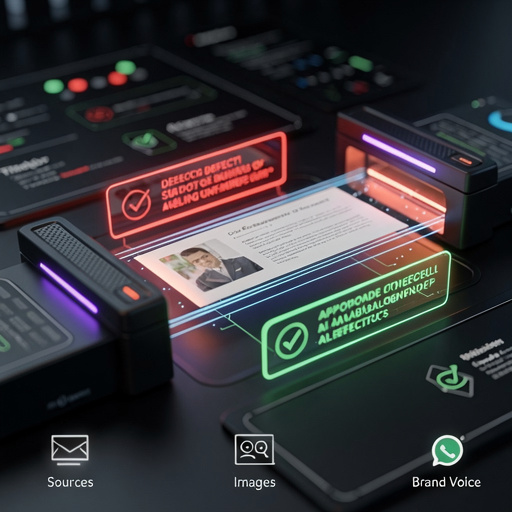
- QA gates (block bad outputs)
- policy enforcement (legal, privacy, security, brand)
- observability (what happened, why, with what data)
- audits & evals (does it behave across edge cases?)
- rollback and incident response (what happens when it fails?)
If you squint, this starts to resemble mature industries:
- aviation (checklists, redundancy)
- finance (audit trails)
- manufacturing (inspection systems)
The future belongs to organizations that treat AI as a production system, not a magic trick.
What gets commoditized (and what doesn’t)
A useful way to forecast is to separate what becomes cheap from what remains scarce.
Likely to commoditize
- Baseline text generation: good-enough writing, summarization, and translation.
- Standard analytics: explaining charts, generating SQL, basic forecasting.
- Generic customer support: where policies are clear and issues are repetitive.
- Boilerplate coding: scaffolds, tests, migrations, documentation.
Likely to stay scarce
- Taste and strategy: deciding what matters and why.
- Domain accountability: signing your name to a decision.
- Data access and data quality: the “garbage in” problem doesn’t go away.
- Trust engineering: QA systems, eval harnesses, audits, monitoring.
- Distribution: getting outputs into the world, into workflows, into revenue.
In other words: the model is not the company. The system is the company.
Work and the economy: where disruption actually lands
A lot of AI discourse is either utopian (“everyone will be freed”) or apocalyptic (“no one will work”).
Reality will be more boring and more brutal: jobs will be reorganized into smaller units, then partially automated, then re-aggregated.
What’s changing is not just productivity—it’s the shape of work.
The big shift: from craft to production
Many knowledge roles have historically been judged by effort (“hours worked”) or by ambiguous output (“good writing”).
As AI takes on the first draft of everything, the human role shifts toward:
- defining constraints
- reviewing for correctness
- handling edge cases
- owning outcomes
- improving the system
That’s why we’ll see more “operator” roles: people who manage systems of automated work, not individual tasks.
The uneven impact
Expect disruption where these conditions hold:
- the work is language-heavy,
- quality can be measured,
- and the workflow can be standardized.
Expect resilience where:
- trust is hard to earn,
- accountability is personal,
- and the environment is adversarial or deeply physical.
Governance: why regulation will look like finance + aviation
Regulation is often discussed as if it’s a switch: regulated vs unregulated.
The future is more layered.
We’ll likely see:
- sector-specific rules (health, finance, critical infrastructure)
- disclosure norms (what data was used? what model? what tests?)
- audit expectations (logs, reproducibility)
- liability shifts (who is responsible when an agent takes action?)
The trend is clear: when AI touches money, health, identity, or safety, it will inherit the compliance gravity of that domain.
A practical playbook: how to prepare now
If you want to be early and right (not just early), build around these principles.
1) Treat AI like production capacity
Define:
- unit of work
- throughput target
- acceptable defect rate
- cycle time
If you can’t measure it, you can’t scale it.
2) Build the trust layer first
Before you “automate,” implement:
- guardrails
- QA checks
- escalation paths
- logging and evaluation
This is what turns “it works in a demo” into “it works every day.”
3) Integrate where context lives
AI without context is a hallucination machine.
Connect it to:
- your systems of record
- your policies
- your knowledge base
Then force citations and traceability.
4) Redesign roles, not just tools
The productivity boost shows up when you redesign the workflow:
- fewer handoffs
- clearer acceptance criteria
- more automation around the edges
Otherwise you just create faster chaos.
What I’d bet on in 2030
If you forced me to make concrete bets:
- Agents will be normal: most software will ship with built-in autonomous workflows.
- AI ops becomes a discipline: evals, incident response, red-teaming, and QA engineering become standard.
- Interfaces change: less clicking, more intent + verification (you approve actions, not drafts).
- Intelligence gets embedded: the distinction between “AI product” and “product” collapses.
- Trust becomes the differentiator: the winners are the systems with the best inspection and governance.
The future of AI isn’t “smarter chat.” It’s reliable action.
Call to Action
- Explore Poly: https://www.poly186.com
- Book a demo: https://www.poly186.com/demo
- Read the docs: https://docs.poly186.com
- Join the waitlist: https://www.poly186.com/waitlist
Sources
- Stanford HAI, AI Index Report (annual): https://aiindex.stanford.edu/report/
- OECD, AI Principles: https://oecd.ai/en/ai-principles
- NIST, AI Risk Management Framework (AI RMF 1.0): https://www.nist.gov/itl/ai-risk-management-framework
- European Union, AI Act (official portal): https://artificialintelligenceact.eu/
- ISO/IEC 23894:2023, AI risk management (overview): https://www.iso.org/standard/77304.html