
The End of Knowledge Work as We Know It: Managing AI Workers Like a Factory

Table Of Content
- TL;DR
- Why the factory metaphor is suddenly literal
- Knowledge work already has a supply chain
- The new primitives: throughput, error rate, cycle time
- QA gates are the real moat
- Workcells, not chatbots
- The management layer becomes the product
- The Poly stance: AI workers should own outcomes
- What to do next
- Sources
The End of Knowledge Work as We Know It: Managing AI Workers Like a Factory
TL;DR
- “AI workers” aren’t assistants; they’re repeatable production capacity.
- If you can’t measure throughput, error rate, and cycle time, you can’t scale AI.
- The winning orgs will run knowledge work like a factory: inputs → workcells → QA gates → outputs.
- The bottleneck shifts from “writing prompts” to designing inspection systems.
- Poly is built to deploy KPI-owned AI workers that ship outcomes, not tasks.
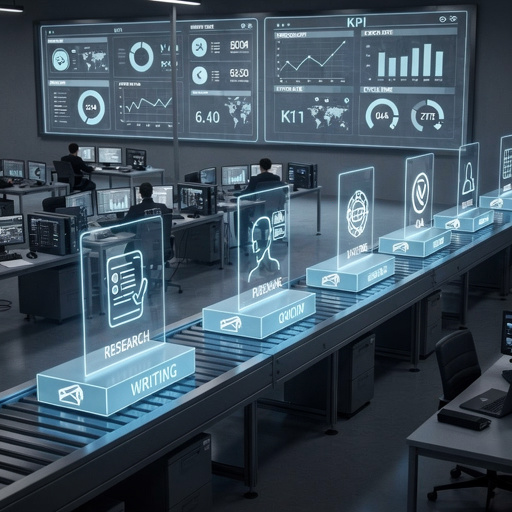
Why the factory metaphor is suddenly literal
For decades, we treated knowledge work as “craft.” A smart person with a laptop. A Slack thread. A Google Doc. A few heroic nights.
That model survives because humans are flexible. When the inputs are messy, the human brain does on-the-fly reconciliation.
AI changes the economics. Once you can spin up 10, 100, or 1,000 workers, your advantage no longer comes from individual brilliance—it comes from systems design.
Factories are not “industrial” because they make physical things. They’re industrial because they:
- standardize inputs
- instrument the process
- enforce QA gates
- measure outputs
- continuously reduce defects
When your “workers” are AI agents, those same constraints apply.
Knowledge work already has a supply chain
Even if your org doesn’t call it that.
A typical blog post, outbound campaign, sales enablement doc, or customer onboarding flow already moves through a pipeline:
- a brief enters
- research happens
- draft is produced
- review happens
- edits happen
- publishing happens
- performance is tracked
The problem is: most teams run that pipeline implicitly.
Which means the process is invisible.
And when the process is invisible, you can’t scale it.
The new primitives: throughput, error rate, cycle time
If you want to manage AI workers like production capacity, you need factory metrics.
1) Throughput
How many units of work are produced per time period?
Examples:
- posts published per week
- leads enriched per day
- support tickets resolved per hour
2) Error rate
How often does the output fail QA?
Examples:
- % of blog drafts rejected due to missing sources
- % of outbound emails that violate brand voice
- % of support replies requiring human correction
3) Cycle time
How long from input → validated output?
Examples:
- time from “create draft” → “published”
- time from “new lead” → “qualified + routed”
These three numbers tell you if your AI system is actually doing work—or just generating text.
QA gates are the real moat
Here’s the uncomfortable truth: the models are converging.
Your “secret sauce” won’t be a prompt.
It will be:
- what you check
- how you check it
- what you block
- what you auto-fix
- what you escalate to humans
In other words: inspection.
A good AI pipeline isn’t “smart.” It’s disciplined.

Example: publishing QA
A blog publishing worker should block posts with:
- placeholder links (
#,javascript:void(0)) - missing hero image
- images without alt text
- missing TL;DR
- missing citations
That’s not creativity. That’s manufacturing.
Workcells, not chatbots
The best mental model isn’t “one AI that does everything.”
It’s workcells.
A workcell has:
- a narrow job
- clear inputs/outputs
- tools it can use
- QA rules
- escalation paths
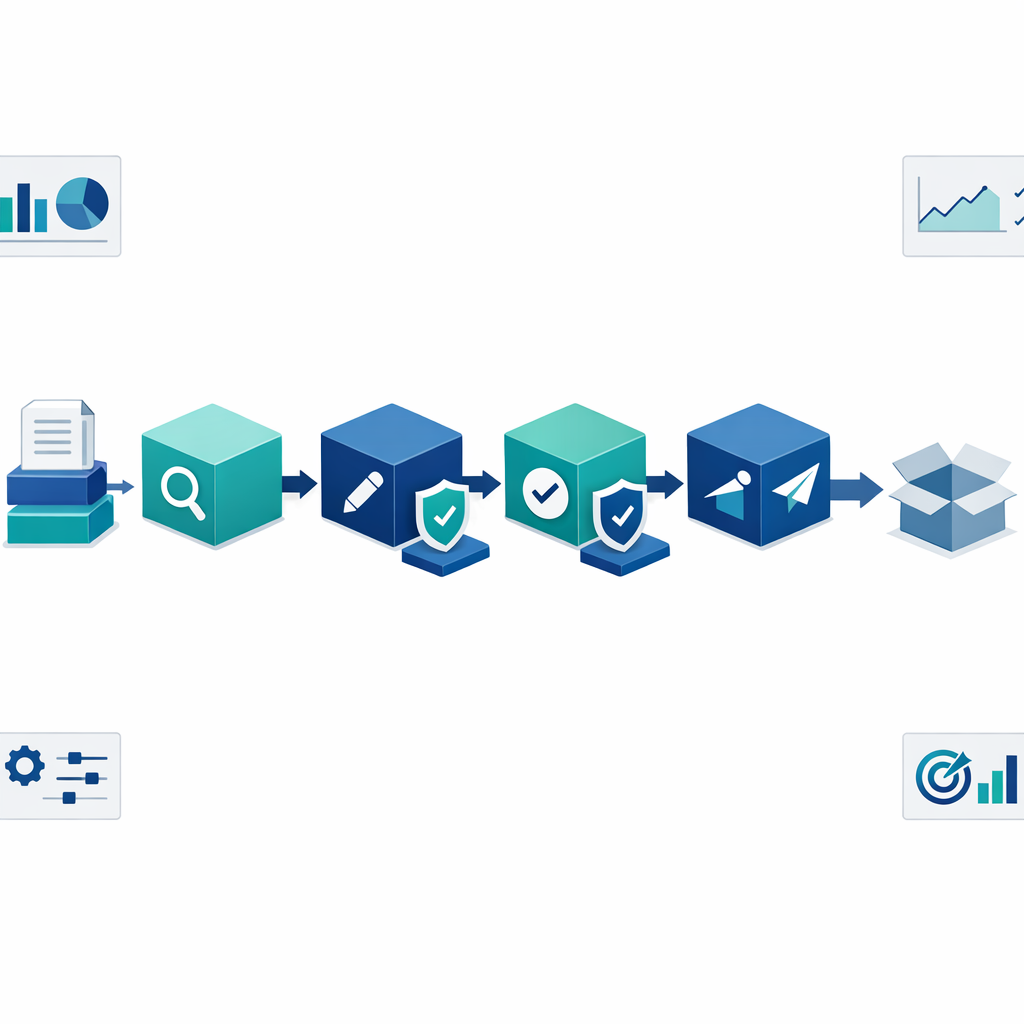
When you compose workcells, you get a factory line.
A research cell feeds a writing cell.
A writing cell feeds a publishing QA cell.
A QA cell feeds a distribution cell.
That architecture is how you get reliability.
The management layer becomes the product
If AI workers are cheap labor, management is what differentiates.
Management means:
- routing
- prioritization
- constraints
- inspections
- post-mortems
- metric tracking
This is why “agentic systems” matter: they create a control plane for digital labor.
The Poly stance: AI workers should own outcomes
Most automation tools ship tasks.
Poly ships workers.
A worker is accountable to KPIs. It doesn’t just fire a Zap. It:
- verifies inputs
- executes steps
- checks quality
- reports evidence
- improves over time
That’s how you get 24/7 capacity without brittle ops.
What to do next
If you’re building with AI right now, don’t start by asking:
“What can we automate?”
Start by asking:
“What production line do we want?”
Then design:
- the unit of work
- the workcells
- the QA gates
- the metrics
- the escalation paths
That’s the blueprint for scaling knowledge work.
Call to Action
- Learn how Poly deploys KPI-owned AI workers: https://www.poly186.com
- Book a demo: https://www.poly186.com/demo
- Read the docs: https://docs.poly186.com
Sources
- W. Edwards Deming, Out of the Crisis (MIT Press): https://mitpress.mit.edu/9780262541152/out-of-the-crisis/
- Donella Meadows, Thinking in Systems: https://www.chelseagreen.com/product/thinking-in-systems/
- Eliyahu M. Goldratt, The Goal: https://www.goodreads.com/book/show/113934.The_Goal