
Sustainable Automation for Small Teams: How SMBs Can Cut Waste, Not Headcount
Table Of Content
- TL;DR
- SEO (Publish-Ready)
- CTA (On-page)
- Why sustainability feels out of reach for small teams
- Sustainable automation = doing less of the wrong work
- Where small teams can start: 3 high-impact workflow categories
- How sustainability shows up in the day-to-day
- Why SMBs are actually better positioned than enterprises
- A simple framework to choose your first sustainable automations
- What working with Agency of Poly looks like
- If you’re an SMB leader, here’s your next step
- Sources
Sustainable Automation for Small Teams: How SMBs Can Cut Waste, Not Headcount
TL;DR
- Sustainability is an operations problem for SMBs: reduce rework, duplication, and manual handoffs.
- Lightweight workflow automation can cut waste (time, materials, energy) without adding headcount.
- Start with 2–3 workflows (reporting, approvals, vendor management) and measure outcomes.
- Design defaults so the lower-waste option becomes the easiest option.
- Agency of Poly can help you map, prioritize, and implement a practical 90-day automation plan.
SEO (Publish-Ready)
Proposed SEO Title: Sustainable Automation for SMBs: Cut Waste, Not Headcount
Meta Description (155–160 chars): Practical ways SMBs can use lightweight workflow automation to reduce operational waste, lower emissions, and free up team capacity—without new platforms.
Target Keywords/Phrases (3–5):
- sustainability automation for SMBs
- workflow automation for small business operations
- reduce operational waste with automation
- sustainable business processes
- operations automation for SMB teams
Suggested Internal Links:
- Poly is a Business Operating System (Not Another Tool) → https://www.poly186.com/blog/poly-is-a-business-operating-system-not-another-tool
- Managing AI Workers Like a Factory Line (Without Turning Your Team Into Robots) → https://www.poly186.com/blog/managing-ai-workers-like-a-factory-line-without-turning-your-team-into-robots
CTA (On-page)
Ready to make your operations more sustainable (without burning out your team)?
Book a workflow design session with Agency of Poly to map your highest‑leverage automations, estimate impact on cost and emissions, and leave with a concrete 90‑day execution plan.
→ Book a workflow design session
Why sustainability feels out of reach for small teams
If you run a small or mid-sized business, you’re probably hearing the same message from every direction:
- Customers want to buy from more sustainable companies.
- Larger partners are starting to ask about your emissions and supply chain.
- Your own team cares about impact, not just output.
At the same time, your reality looks like this:
- You don’t have a full-time “sustainability” role.
- Your data is scattered across tools, spreadsheets, and email.
- Every improvement project competes with “just getting this week’s work out the door.”
So sustainability ends up in a familiar place:
“We care about this… we just don’t have the capacity right now.”
The mistake is thinking sustainability is a separate initiative that needs new software, new dashboards, and a new team.
For SMBs, sustainability is first an operations problem:
- Where are we duplicating effort?
- Where are we moving data manually between systems?
- Where are we generating waste—time, materials, or energy—because our workflows are inconsistent or opaque?
This is where sustainable automation comes in.
Sustainable automation = doing less of the wrong work
When people hear “automation,” they often picture robots replacing people or AI writing all their emails.
For most small teams, the real opportunity is much more grounded:
- Stop moving the same data between tools by hand.
- Stop rebuilding the same report every week.
- Stop losing time to “Can you resend that file?” and “Who owns this step?”
Sustainable automation means:
-
Designing workflows that are predictable and visible.
Everyone knows the steps, owners, and tools involved. -
Automating the glue work between tools and teams.
The system handles handoffs and updates so people can focus on judgment and relationships. -
Measuring impact not only in hours saved, but also reduced rework, travel, and resource use.
Instead of asking, “What can we automate?” a better question for SMBs is:
“Which recurring workflows generate the most waste if they go wrong or take too long?”
Where small teams can start: 3 high-impact workflow categories
You don’t need a 50-page roadmap to get value from sustainable automation.
Most SMBs see meaningful gains by starting in three familiar areas.
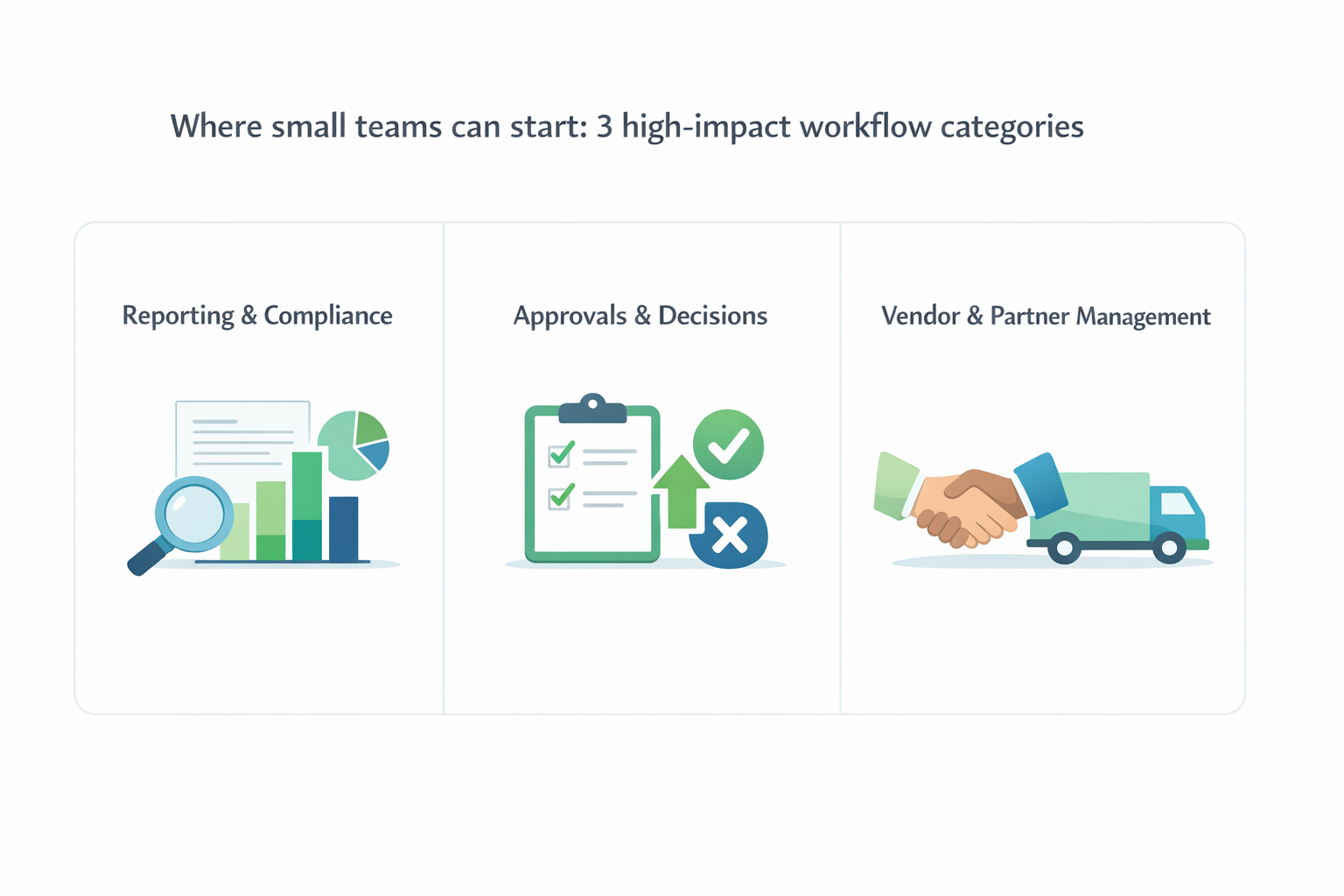
1. Reporting and compliance workflows
Monthly reports, ESG questionnaires from partners, vendor due diligence, internal KPIs—these all rely on the same underlying data. In most small teams, they’re rebuilt from scratch every time.
Common failure modes:
- Data pulled manually from 4–6 different tools.
- No single source of truth for “numbers we trust.”
- Last-minute scrambles to hit a partner’s deadline.
A more sustainable approach:
- Define a core reporting model: the 10–15 fields you reuse across ESG, ops, and finance.
- Automate data collection from your existing tools (CRM, billing, project management) into a shared store.
- Create templates (dashboards or docs) that auto-populate from that store.
Result: fewer manual pulls, fewer errors, and a much clearer baseline for any sustainability commitments you make.
2. Approvals and decision flows
Approvals are invisible sources of waste:
- Purchase approvals stuck in someone’s inbox.
- Travel and vendor decisions made ad hoc instead of against a simple policy.
- Projects paused because a decision-maker is out.
For sustainability, this matters because every delayed or inconsistent decision creates:
- Extra shipments and rush orders.
- Duplicate work and rework.
- Frustrated teams who learn to bypass the process entirely.
Automating approvals doesn’t mean removing judgment. It means:
- Clear thresholds (e.g., “Under $X, auto-approve; over $X, route to finance”).
- Standardized data captured with each request (vendor, category, expected timeline, impact).
- Automated reminders and escalations when something is stuck.
You get faster, more consistent decisions—and a cleaner record of how choices get made.
3. Vendor and partner management
Sustainability is a team sport. Your footprint is shaped not just by your own behavior, but by the tools, suppliers, and partners you choose.
For SMBs, vendor management is often:
- Scattered across email threads and personal spreadsheets.
- Driven by “who we’ve always used” instead of clear criteria.
- Re-evaluated only when something breaks.
Sustainable vendor workflows look different:
- Maintain a lightweight, shared vendor database (even if it’s just a structured table).
- Ensure each vendor record includes key sustainability and reliability signals.
- Keep onboarding, review, and offboarding in a simple, documented flow.
With a bit of automation, you can:
- Trigger an annual review workflow for high-impact vendors.
- Route new vendor requests through the right checks automatically.
- Keep your team working from the same up-to-date view.
How sustainability shows up in the day-to-day
It’s easy to treat sustainability as an abstract goal. In practice, it lives in small, repeated decisions:
- Do we ship this in one consolidated batch or three separate packages?
- Do we fly for this meeting or run a structured remote review?
- Do we throw away this data after one report, or design a workflow that reuses it for the next five?
When workflows are opaque and ad hoc, people make decisions based on whatever is easiest in the moment.
When workflows are designed and lightly automated, you can build sustainability into the default path:
- The form encourages the lower-waste option.
- Routing rules favor consolidated shipments.
- Report templates pull from a shared dataset instead of a one-off export.
This isn’t about policing behavior. It’s about designing systems that make the sustainable choice the obvious one.
Why SMBs are actually better positioned than enterprises
Large enterprises have more budget, but they also have heavier legacy systems, longer approval chains, and more political friction around changing processes.
Smaller teams, by contrast, can:
- Redesign a workflow in days, not quarters.
- Pilot an automation with one squad today and scale it next week.
- Align around a simple operating system for how work flows across tools.
You don’t need a “sustainability transformation.” You need:
- A clear map of your current workflows.
- A short list of high-waste areas.
- A lightweight automation plan your existing team can own.
A simple framework to choose your first sustainable automations
If you’re not sure where to start, use this quick scoring model.
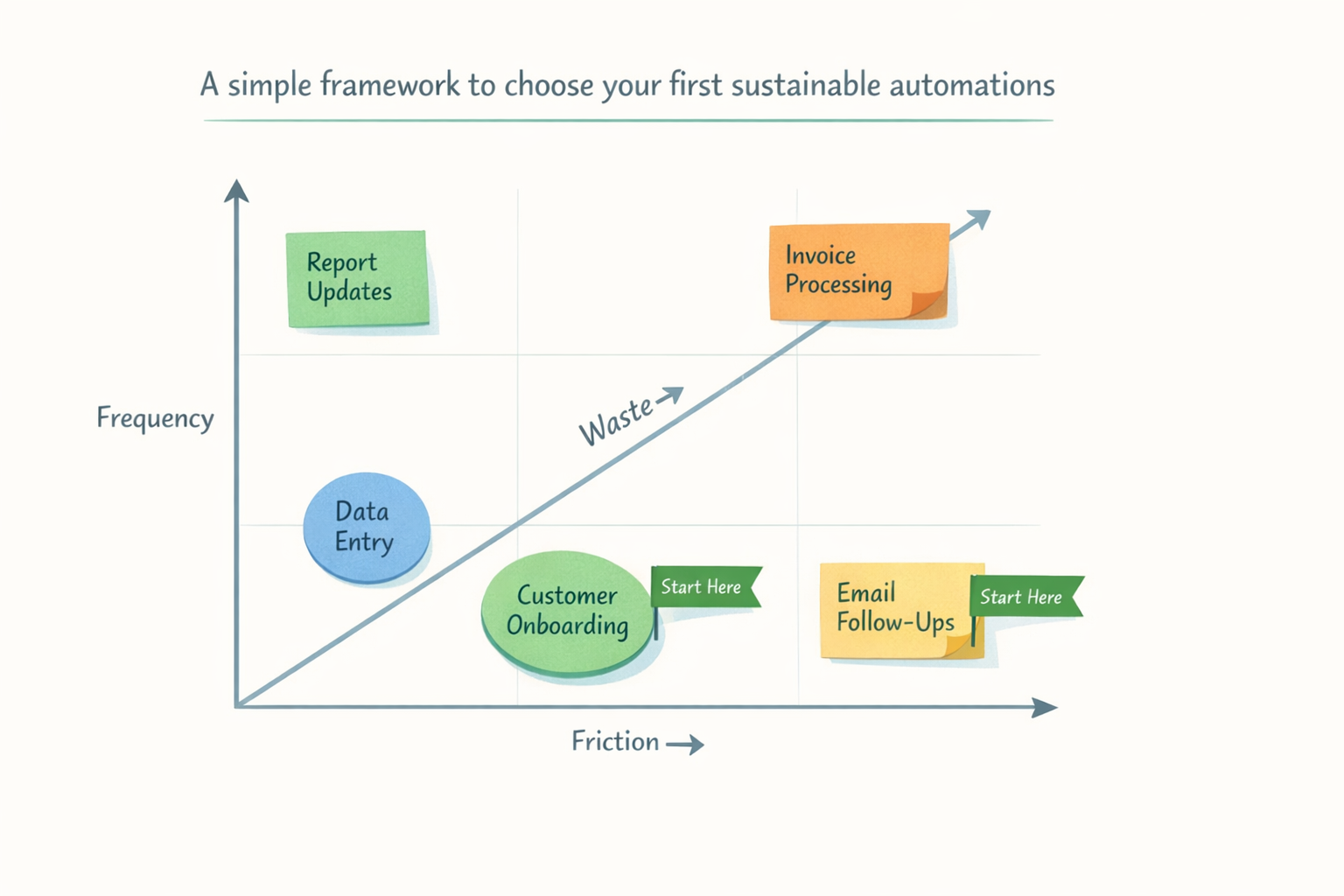
For each recurring workflow (e.g., monthly reporting, vendor onboarding, client onboarding, inventory updates), score from 1–5 on:
- Frequency – How often does this run?
- Friction – How painful is it today for the people involved?
- Waste – How much rework, excess material, or duplicated effort does it generate when it goes wrong?
Then calculate: Frequency + Friction + Waste.
Start with the 2–3 workflows with the highest scores.
For each one, ask:
- What data do we collect every time, and where does it live today?
- Which steps are purely “glue work” (copy-paste, forwarding, updating statuses)?
- What would it look like if this workflow ran on rails—predictable, visible, and mostly self-moving?
Those questions become the brief for your first sustainable automation sprint.
What working with Agency of Poly looks like
Many SMB leaders we speak with are already convinced automation matters. What they’re missing is the time and structure to move from ideas to implementation.
Our work together typically looks like this:
-
Workflow mapping and prioritization
We map your core operational workflows, identify the highest-waste areas, and align on 2–3 candidates for sustainable automation. -
Impact and feasibility check
We estimate time saved, error reduction, and potential sustainability impact (e.g., fewer shipments, less rework, less travel) for each candidate. -
Designing the automation layer
We design how data and tasks should flow across your existing tools—no rip-and-replace—and define clear owners. -
Implementation and iteration
We build or orchestrate the automations, then refine them based on how your team uses them. -
Ongoing measurement
We help you track operational and sustainability metrics so you can tell a clear story to customers, partners, and your own team.
The goal is not to automate everything. It’s to remove enough operational waste that your team has the headroom to keep improving.
If you’re an SMB leader, here’s your next step
You don’t need another deck about why sustainability matters. You need a concrete, workable plan for your specific workflows.
If you’d like a partner who understands both the operations side and the sustainability ambition, Agency of Poly can help.
Book a workflow design session and we’ll:
- Map your 3–5 highest-waste workflows.
- Identify where lightweight automation can reduce both time and emissions.
- Outline a 90-day execution plan your current team can own.
→ Book your workflow design session