
Poly Is a Business Operating System (Not Another Tool)

Table Of Content
- TL;DR
- Introduction: The Hidden Tax of Tool Chaos
- The Visual We’re Shipping (and Why It Matters)
- The Strategy Command Center: Where KPIs Become Real
- The Four Districts: How Execution Actually Works
- The Council: The Feedback Layer Most Teams Are Missing
- Why This Release Matters (Even If You Don’t Use Poly)
- Conclusion: The Point Isn’t AI. It’s Control.
- Sources
- Call to Action
Poly Is a Business Operating System (Not Another Tool)
TL;DR
- Most teams don’t need “more tools” — they need an operating system that turns strategy into execution.
- Poly is built around a Strategy Command Center that cascades KPIs from Company → Workspace → Product → Workflow.
- From that core, Poly connects Pipelines, Workflows, Tasks+Reports, and Outcomes so execution is measurable and auditable.
- The Council layer detects gaps, creates tasks, and recommends KPI optimizations.
- The goal is simple: More Revenue. Less Chaos.
Introduction: The Hidden Tax of Tool Chaos
If you’ve ever felt like your business is “running,” but not actually moving, you already know the problem.
Not because you’re lazy. Not because your team is dumb. Because your company is being held together by a messy stack of tools, half-working automations, and people remembering critical steps in their heads.
The result: execution drift.
You set strategy. You start strong. Then reality hits:
- work gets scattered across tools
- ownership gets fuzzy
- reporting becomes theater
- and revenue growth starts to feel like “add headcount, add stress”
Poly exists because we got tired of watching good teams drown in operational entropy.
So we built something different:
A Business Operating System designed to convert strategy into execution — and prove it worked.
The Visual We’re Shipping (and Why It Matters)
Here’s the poster that captures the release concept:
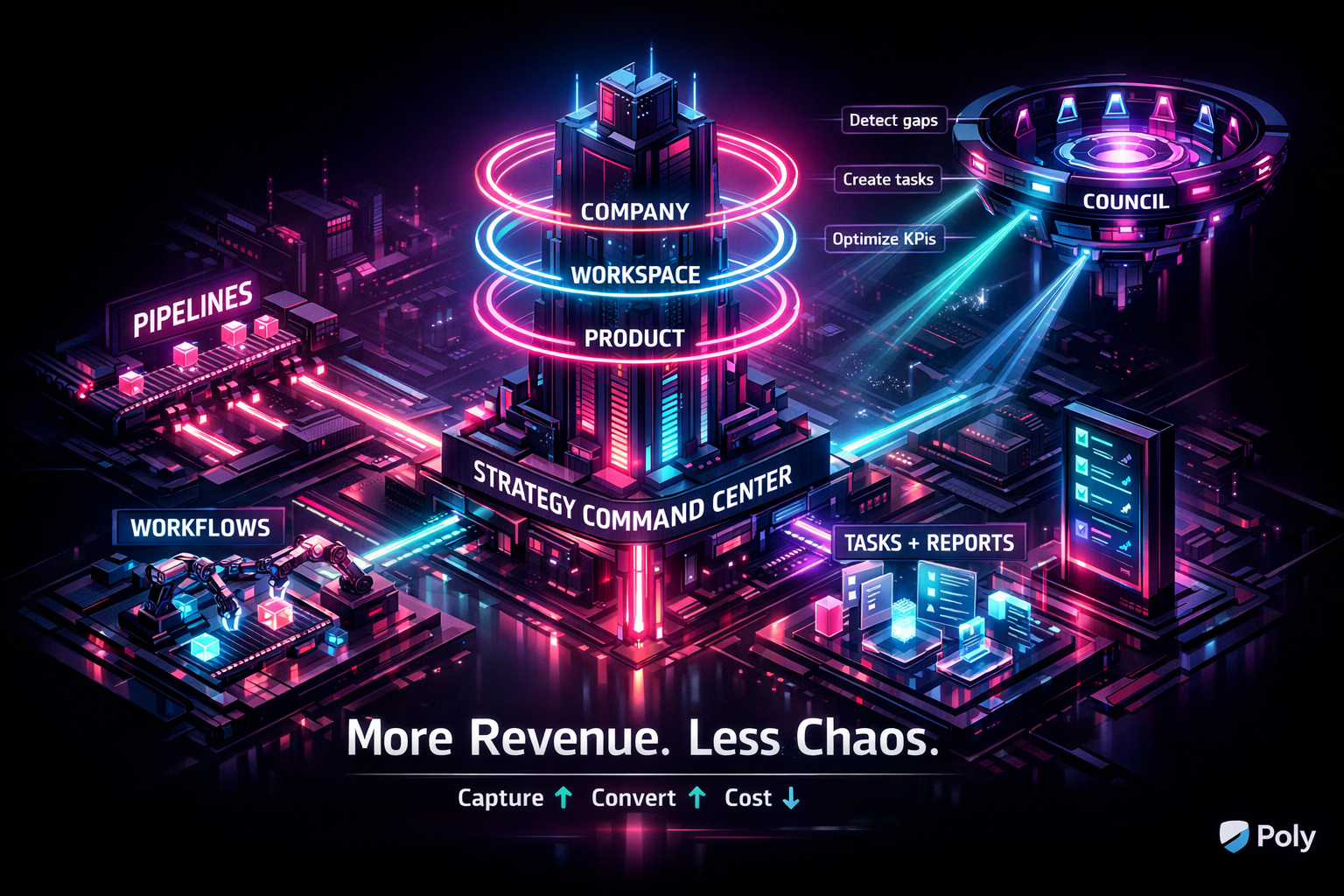
Figure: Poly visualized as an isometric “OS city” where strategy routes into execution systems and outcomes.
At the center is the Strategy Command Center. Around it: KPI rings. Branching outward: districts that represent the execution engine.
It’s not just art. It’s the product philosophy.
The Strategy Command Center: Where KPIs Become Real
Most orgs have KPIs. The issue is they don’t compile.
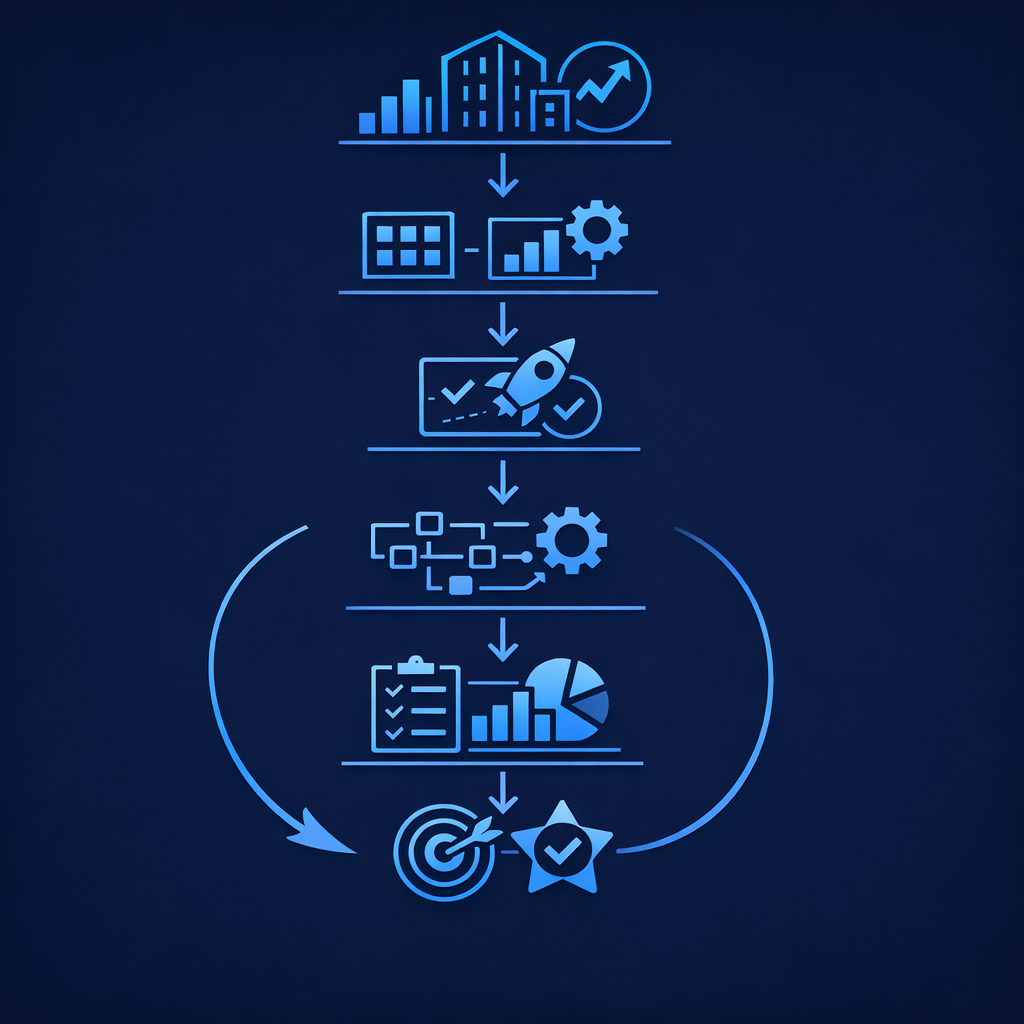
Poly’s Strategy Command Center makes KPIs flow down a clean hierarchy:
- Company KPIs (top-level outcomes)
- Workspace KPIs (team-level accountability)
- Product KPIs (what’s shipped / sold)
- Workflow KPIs (what actually happens day-to-day)
That cascade matters because it forces one question:
“If the KPI is slipping, which workflow is leaking — and what are we doing about it?”
Here’s the mental model:
The Four Districts: How Execution Actually Works
Once strategy is defined, Poly routes execution through four connected systems:

1) Pipelines (Capture)
Pipelines move leads, opportunities, and conversations forward.
Not “we have a CRM.” We mean: a pipeline that actually moves every day without heroic effort.
2) Workflows (Convert)
Workflows are the repeatable engines: onboarding, follow-ups, fulfillment, reporting, QA.
This is where “automation” usually breaks — because point solutions don’t own the full loop.
Poly’s approach is orchestration: workflows that can span tools, humans, and digital workers.
3) Tasks + Reports (Auditability)
This is the part most automation tools ignore.
Poly treats execution like a system that must be provable:
- tasks are created with clear ownership
- reports show what happened
- and you get an audit trail instead of vibes
4) Outcomes (Revenue / Cost / Speed)
Execution only matters if it turns into outcomes you can measure.
Outcomes aren’t just dashboards — they’re the accountability layer that closes the loop back to strategy.
The Council: The Feedback Layer Most Teams Are Missing
Here’s where it gets interesting.
Poly includes a Council layer that sits above execution, watching for gaps:
- Detect gaps (what’s not happening that should be happening?)
- Create tasks (what needs to be done next, by who?)
- Optimize KPIs (are we measuring the right thing, or gaming ourselves?)
This is the difference between “automation” and “a living system.”
In plain language: the Council helps the OS self-correct.
Why This Release Matters (Even If You Don’t Use Poly)
You can steal the idea even if you ignore the product:
Your business needs an operating system.
Because without one, strategy becomes a mood board. And execution becomes a game of telephone across tools.
The release is our attempt to make that OS visible — in a single image and a single line:
More Revenue. Less Chaos.
Capture ↑ Convert ↑ Cost ↓
Conclusion: The Point Isn’t AI. It’s Control.
AI is cool. But “AI” isn’t the point.
The point is control:
- control over execution
- control over accountability
- control over whether your growth creates freedom or chaos
Poly is built to give that control back — by turning strategy into an operational system that ships, measures, and improves.
Sources
- PwC – AI agent survey (May 2025): https://www.pwc.com/us/en/tech-effect/ai-analytics/ai-agent-survey.html
- VentureBeat – Why 2025 will be the year of AI orchestration: https://venturebeat.com/ai/three-ways-2025-will-be-the-year-of-agentic-productivity
Call to Action
- Try Poly / request a demo: https://www.poly186.com/demo
- Read the docs: https://docs.poly186.com